
Referral-led firm? Your website still decides the enquiry
By Nazreen Daud, Founder of Roquepress · Published 7 Nov 2026 · Last updated: 7 Nov 2026
Short answer: Referrals bring accountants most of their clients, and a 2025 Australian survey backs that up. But a referral only gives someone your name. In my view, your website still decides whether that name turns into an enquiry, because most people look you up before they call.
In this guide:
- What the survey says
- Why the website still matters
- What a referred visitor needs
- 10-second homepage check
- Asking for referrals
- Outside accounting and Australia
- FAQ
Do most accounting clients really come from referrals?
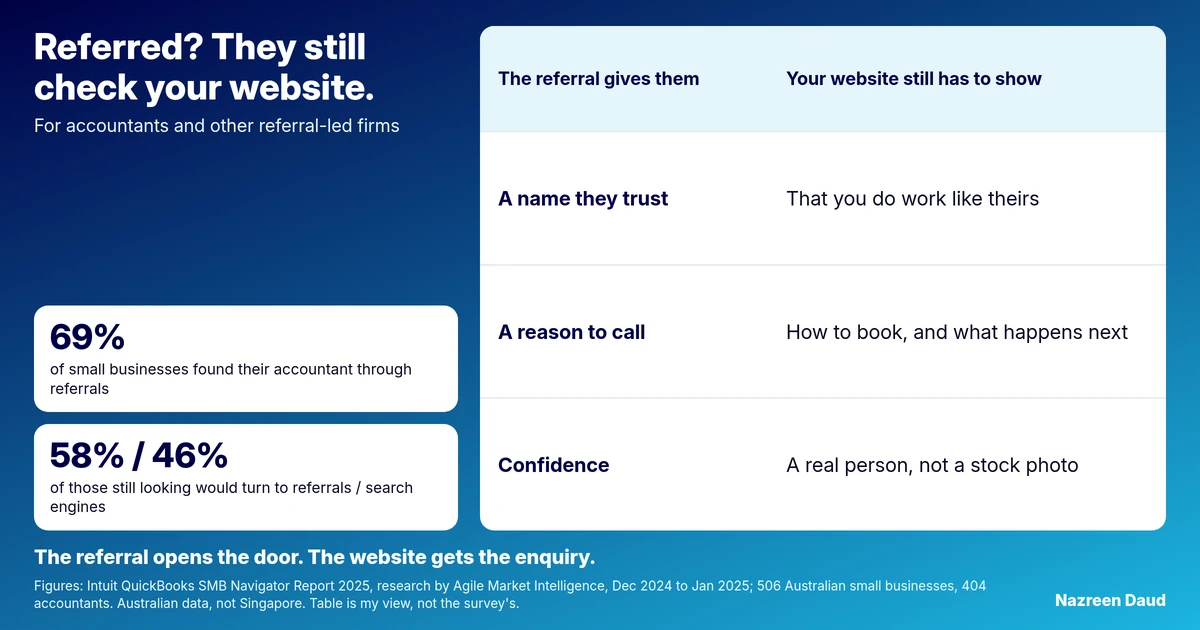
Yes, at least in Australia. The Intuit QuickBooks SMB Navigator Report 2025 found that 69% of small businesses found their accountant through referrals. The research was done by Agile Market Intelligence between December 2024 and January 2025, with 506 Australian small businesses and 404 practising accountants.
Two more numbers from the same report are worth knowing:
- For businesses still looking for an accountant, 58% would turn to referrals and 46% to search engines.
- 9 out of 10 accounting firms rely on word of mouth as their main way to grow.
The figures come from Agile Market Intelligence's summary of the report (Jessica Afalla, 22 Aug 2025), and Accountants Daily reported the same numbers. I haven't seen the full report PDF, so I'm quoting the published summary.
So referrals work. Keep asking for them. Nothing below says otherwise.
Why does a referral-led firm still need a good website?
This part is my view, not the survey's. The report doesn't measure what referred people do before they get in touch.
Look at the 58% and the 46% together. Those groups overlap. A friend says "use my accountant", and the next thing most people do is search your name before they pick up the phone.
That search is a quiet test. They already have a reason to trust you. What they're checking is whether you look like the right fit for someone like them, and whether getting started looks easy.
Think of the referral as a friend walking someone to your front door. Your website is the door. If it's locked, unmarked or looks like the wrong address, the friend's good word doesn't get them inside.
What does a referred visitor need to see?
A referred visitor needs four things fast: who you help, proof you've done work like theirs, a real person, and how to start. The referral covers trust. The website covers the rest.
| What the referral gives them | What your website still has to show |
|---|---|
| A name they trust | That you do work like theirs |
| A reason to call | How to book, and what happens next |
| Confidence | A real person, not a stock photo |
A little more on each:
- Who you help, in plain words. "We help Singapore F&B owners with bookkeeping and tax" beats "Comprehensive financial solutions". A café owner should see themselves in the first line.
- Proof like theirs. A short example of a client in their industry, a list of the sectors you work with, or a testimonial from a similar business. Only real ones.
- A real face. Your photo and your team's, with names. Referred people were told about a person, so show them that person.
- How to start, and what happens next. One clear button, then a line such as "we'll reply within one working day and book a 20-minute call". Vague "contact us" pages make people put it off.
How do I check my homepage in 10 seconds?
Open your homepage on your phone, start a timer for 10 seconds, and look only at the first screen. Pretend a friend just recommended you.
- Can you tell who the firm helps? Not what it does in general: who it's for.
- Is there a real person on the screen, or one tap away?
- Is there one obvious next step? A button that says "Book a call" or "Get in touch", not five competing links.
- Would a referred stranger know what happens after they tap it?
If you answer no to any of these, that's the first fix. Most of them are copy changes, not a rebuild. If the site has been left alone for months, the gaps often cost more than a copy pass. See the true cost of ignoring your website.
Want a second pair of eyes on your homepage? Book a call with us and we'll run the check together.
How do you ask clients for referrals without it feeling awkward?
Most firms don't ask. The same report found that only 38% of accounting firms explicitly ask the majority of their clients to refer them to peers, and only 6% ask all their clients.
My suggestions, from working with service businesses rather than from the survey:
- Ask after a good moment. Right after you've filed on time, saved them money or sorted a messy year, say "if you know anyone who needs the same, I'd be glad to help them".
- Make it easy to pass on. Give them one link to share, ideally a page that says who you help. That's where the website and referrals meet.
- Say thank you. A short note to the client who referred someone, whether or not the referral signs.
Does this apply outside accounting, and outside Australia?
The data is Australian and about accountants, so treat it as that, not as Singapore research.
My own observation, not from the survey: I see the same pattern with referral-led firms in Singapore, from accountants to lawyers to clinics. Clients arrive with a name, then check the website before they get in touch. If you run a professional services firm here, the 10-second check applies to you too.
Who this isn't for
This isn't for large firms with a marketing team and a full lead pipeline. It's for owner-led practices where most work comes by word of mouth, and the owner can change the homepage copy this month.
FAQ
Do accountants need a website if most clients come by referral?
Yes. In the Intuit QuickBooks SMB Navigator Report 2025 (Australia), 69% of small businesses found their accountant through referrals. In my view, referred people still look you up before they call, so the website is often the step between hearing your name and making an enquiry.
What should an accountant's homepage show first?
Who you help, in plain words, a real person, and one clear way to get in touch. Add a line about what happens after someone enquires, such as when you'll reply. Proof from a similar client, if you have it, should be close by.
How do I ask clients for referrals without being awkward?
Ask right after a good moment, such as a deadline met or a problem solved. Keep it short and give them a link that's easy to forward. The report found only 38% of accounting firms ask most of their clients, so simply asking already sets you apart.
Does this apply to lawyers, clinics and consultants?
The survey only covers accountants and small businesses in Australia. From my own work, I see the same pattern with referral-led firms in Singapore, including lawyers and clinics: a referral brings the name, and the website has to turn it into a booking.
Is this data from Singapore?
No. The SMB Navigator Report 2025 surveyed 506 Australian small businesses and 404 practising accountants between December 2024 and January 2025. Treat every figure here as Australian data. The Singapore point in this article is my own observation, not research.
Make the referral count
Run the 10-second check on your homepage today. If the gaps are in who you help, how to book or what happens next, that's the work we do at Roquepress. Book a call or see how we build websites for professional services firms.
About the author: Nazreen Daud is the Founder of Roquepress, a Singapore web and digital services company that builds websites and follow-up systems for service businesses. Read Nazreen's bio