
Clinic Website Online Booking in Singapore: Can Patients Book at 9 PM?
By Nazreen Daud, Founder of Roquepress · Published 4 Nov 2026 · Last updated: 4 Nov 2026
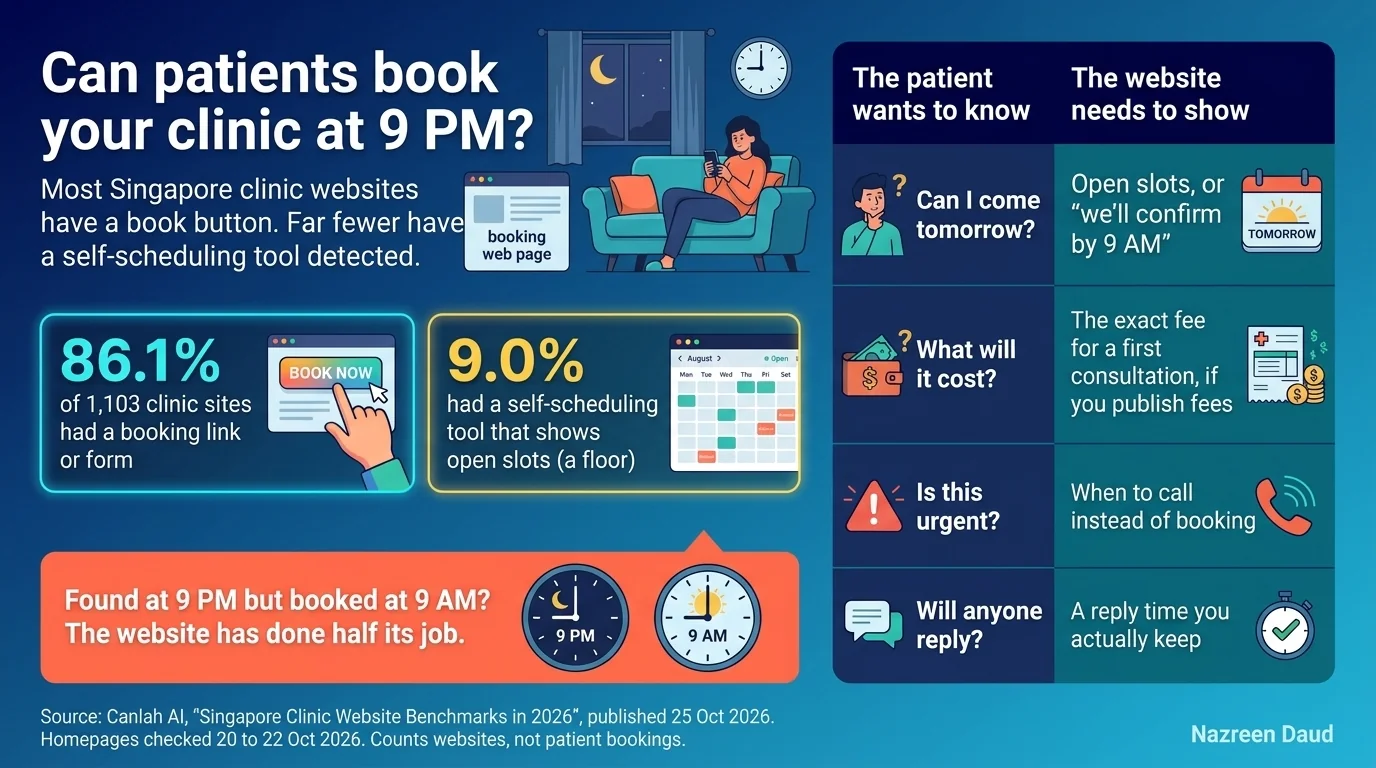
Short answer: Most Singapore clinic websites offer online booking in name only: they have a "Book" button, but few show open slots. In Canlah AI's October 2026 check, 86.1% of 1,103 clinic sites had a booking link or form, and a self-scheduling tool was detected on 9.0%. A patient who finds you at 9 PM should know what happens next.
In this guide:
- The 9 PM toothache
- What the data says
- Button, scheduler or WhatsApp
- By clinic type
- The 9 PM table
- 10-minute check
- When live booking isn't right
- My view
- FAQ
The 9 PM toothache: what is the patient actually asking?
A patient searching at night wants to know whether they can be seen soon, roughly what it will cost, and whether anyone will get back to them.
Here's a made-up example, not a real clinic.
It's 9 PM on a Tuesday. Someone has a molar that started throbbing over dinner. They open Google Maps, type "dentist near me", and tap through to a clinic.
The website has a "Book an appointment" button. They tap it, fill in a form and get "Thank you, we will contact you."
The page never says when. So they go back to the map and try the next clinic, just in case.
How many Singapore clinic websites offer online booking?
Booking links are everywhere; booking tools are not. Canlah AI checked 1,287 unique clinic websites linked from 3,145 private-clinic Google Maps listings, with data collected from 20 to 22 Oct 2026. Of the 1,103 sites that loaded without a bot check, 86.1% had a booking link or form, but a named self-scheduling tool was detected on 9.0%, about one in 11.
The study is Canlah AI's Singapore Clinic Website Benchmarks in 2026, published 25 Oct 2026. Canlah AI is a Singapore SEO and AI-search agency that also sells clinic website services, so treat this as vendor research. Its method and limits are laid out clearly on the page.
Two things are worth knowing before you quote it:
- 9.0% is a floor. In Canlah's words, "the check looked for known scheduler products in the homepage code and custom-built schedulers can be missed."
- It measures websites, not patients. It covers homepages only. It does not tell us how many patients booked, how many gave up, or how many enquiries clinics received.
What is the difference between a booking button and online booking?
A booking button and online booking look alike, but they promise different things. A button that opens a form sends a request that staff confirm later. A self-scheduling tool shows open slots and lets the patient book one there and then.
Canlah draws the same line: a booking link or form "can lead to a request that staff confirm later, while a scheduler shows open slots and books one."
- Request form. The patient leaves details and waits for staff to confirm. Fine if the clinic says when it will reply, and then does.
- Self-scheduling tool. The patient sees open slots, picks one and gets a confirmation. They can go to sleep with an appointment.
- WhatsApp link. The patient sends a message, and what happens next depends on who is holding the clinic phone tonight. Canlah found 67.4% of the 1,103 sites link to WhatsApp click-to-chat, so for many clinics this is the real front door.
A request form is a doorbell at a shop that has closed for the night. Someone will hear it in the morning. A scheduler is the shop leaving its appointment book open at the door with a pen beside it. Only one tells the visitor what happens next without anyone answering.
Which types of clinic offer self-scheduling most?
Self-scheduling was most common on allied health and specialist sites and least common on medical aesthetic sites. In every segment it was detected on roughly one site in nine or fewer.
| Clinic type (Canlah's segment) | Self-scheduling tool detected |
|---|---|
| Allied health and specialist | 11.0% of 508 sites |
| GP | 10.1% of 148 sites |
| Dental | 8.9% of 258 sites |
| Medical aesthetic | 2.5% of 199 sites |
Source: Canlah AI, Singapore Clinic Website Benchmarks in 2026, data collected 20 to 22 Oct 2026. The floor caveat applies to every row.
My reading, not the source's: the low aesthetic figure doesn't surprise me. Many aesthetic treatments start with a consultation, and a clinic may prefer a conversation before a slot is held. That's a fair choice. It just means the website has to work harder to say what happens after someone taps "Book".
What does a patient need to see on your site at 9 PM?
A patient at 9 PM needs four answers: when they can be seen, what a first visit costs, whether they should call instead, and when someone will reply. Your site can give all four without live booking.
| What the patient wants at 9 PM | What the site needs to show |
|---|---|
| Can I come tomorrow? | Open slots, or a clear line such as "we'll confirm your time by 9 AM" |
| What will it cost? | The exact fee for a first consultation, if you publish fees |
| Is this urgent? | When to call instead of booking, the number to call, and "for emergencies, call 995" |
| Will anyone reply? | A reply time you actually keep |
Only the first row needs software. The other three need a few honest sentences.
If you're a licensed medical or dental clinic, keep every line within MOH's advertising rules. MOH's guidance is to list only exact prices, with no "from" or "as low as", and the rules bar laudatory words such as "best" and before-and-after photos.
How do I check my own clinic website in 10 minutes?
Do this on your phone, not your office computer, because a patient at 9 PM is likely to be on theirs.
- Find yourself the patient's way (1 minute). Search for your clinic on Google Maps and tap the website link. Does it open the right page?
- Find the booking path (1 minute). Can you see a way to book without scrolling past banners?
- Tap it (2 minutes). Do you get open slots, a form or a WhatsApp chat? Fill it in with a test name if you can. While you're there, check the form only asks for what you need to book: no NRIC, and a separate opt-in for any marketing.
- Read what happens after you submit (1 minute). Does the page say when you'll hear back? "We'll contact you" doesn't count; a time does.
- Look for the first-visit cost (1 minute). If you publish fees, is the exact first-consultation fee easy to find?
- Look for the "call instead" line (1 minute). If someone is in pain, does the site say when to call, with a tappable number?
- Check the morning after (2 minutes, the next day). Did your test request reach the right person, and how long did the reply take?
A gap in steps 4, 5 or 6 can usually be fixed with a sentence or two. Step 7 tells you whether the promise on your site is one your team can keep.
Want a second pair of eyes on your booking path? Book a call with us and we'll go through it together.
When is live online booking not right for a clinic?
Live booking isn't right for every clinic or every treatment. If a slot depends on a clinical assessment, or your team can't keep an online calendar accurate, a request form with a clear reply promise may serve patients better. Cases where I'd hold off:
- Treatments that need a conversation first. If the right appointment depends on what the patient tells you, a scheduler can book the wrong thing. A short form plus a fast reply works better.
- Your calendar lives in someone's head. If availability changes all day and nobody updates the scheduler, patients will book times that don't exist, which is worse than a form.
- Urgent or worrying symptoms. Say clearly when to call, or when to seek urgent care instead.
- You can't keep the reply promise. If nobody checks requests until the afternoon, don't write "we'll confirm by 9 AM". Write the time you can actually keep.
In each case, tell the patient exactly what happens next, and then do it.
My view: the website is your night receptionist
This section is my opinion, from building websites and follow-up systems for service businesses. It isn't from the Canlah study.
I think most clinics don't have a booking problem. They have a "what happens next" problem. It's one of the first things I check on a clinic site in Roquepress work.
So my rule is simple. Every booking path on a clinic site should end with a sentence a tired patient can read at 9 PM and feel settled. "Your slot is booked." "We'll confirm your time by 9 AM tomorrow." "If it's urgent, call us now." Pick the one that's true for you.
The follow-up matters as much as the button. A request that sits in an inbox until lunchtime has turned into a missed enquiry. A simple follow-up system, such as an instant acknowledgement plus a named person who checks requests first thing, closes much of that gap.
Who this isn't for
This guide isn't for hospitals, polyclinics or large groups with their own booking platforms and IT teams. It's written for private clinics where the owner can change the website copy this week. It isn't clinical or legal advice about what your clinic can say or offer.
FAQ
How many Singapore clinic websites offer online booking?
In Canlah AI's check (data 20 to 22 Oct 2026), 86.1% of 1,103 sites that loaded had a booking link or form. A named self-scheduling tool was detected on 9.0%, about one in 11. That's a floor, because custom-built schedulers can be missed.
Is a booking form the same as online booking?
No. A booking form sends a request that someone at the clinic confirms later. Online booking, or self-scheduling, shows open slots and lets the patient book one straight away. Both can work well, as long as the patient knows what happens after they press submit.
What should a clinic website say after a patient submits a booking request?
Say when they will hear back, in plain words, such as "we'll confirm your time by 9 AM tomorrow". Add a phone number and when to call instead if it's urgent. Then make sure someone checks requests early enough to keep it.
Make 9 PM easier for your patients
Run the 10-minute check tonight. If the gaps are in the follow-up behind the form, that's the work we do at Roquepress. Book a call or see how we build websites for clinics and wellness businesses.
About the author: Nazreen Daud is the Founder of Roquepress, a Singapore web and digital services company that builds websites and follow-up systems for service businesses. Read Nazreen's bio